







- Neuf

Référence: BAC10
Référence: 3MLTFRSYRINGE
Référence: BAC3
Référence: RETADPEN10


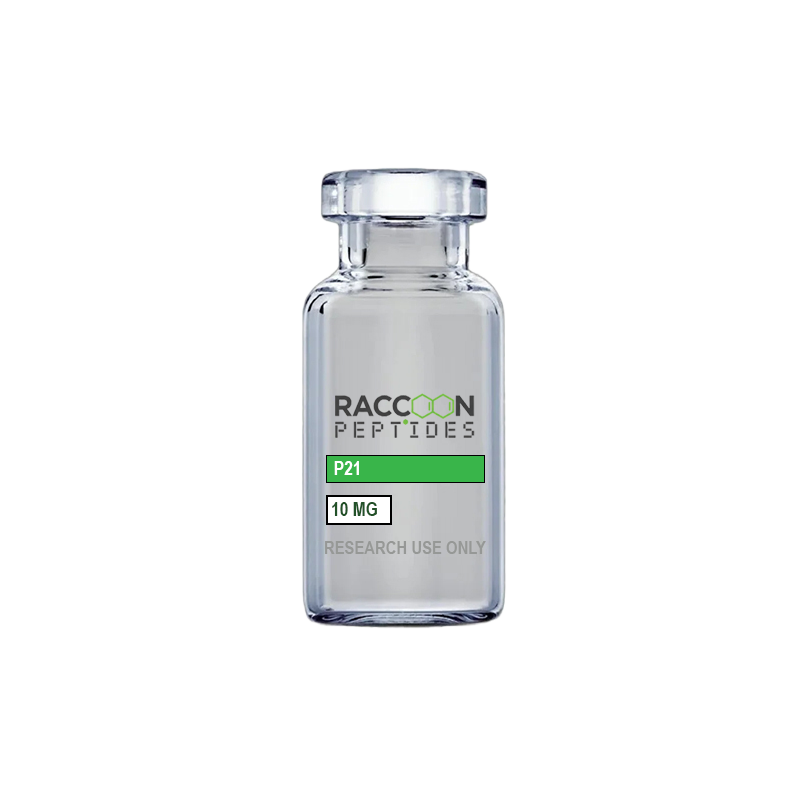
P21 (or P021) is also known as a cyclin-dependent kinase (CDK) inhibitor-1. P21 is a small tetra-peptide derived from the most active region of CNTF (ciliary neurotrophic factor), the amino acid residues 148-151. It is involved in the processes of apoptosis and cell cycle arrest and has been reported to block the activity of cyclin and CDK complexes in animal models.
For research purposes only. This product is supplied exclusively for scientific laboratory research and analytical purposes. It is not intended for human or animal use, and must not be misused in any way that contravenes MHRA regulations or applicable laws.
 Security policy
(edit with the Customer Reassurance module)
 Delivery policy
(edit with the Customer Reassurance module)
 Return policy
(edit with the Customer Reassurance module)
P21 (or P021) is also known as a cyclin-dependent kinase (CDK) inhibitor-1. P21 is a small tetra-peptide derived from the most active region of CNTF (ciliary neurotrophic factor), the amino acid residues 148-151. It is involved in the processes of apoptosis and cell cycle arrest and has been reported to block the activity of cyclin and CDK complexes in animal models.
Natural CNTF is too large to cross the BBB, has poor plasma stability and an unfavorable pharmacological profile. CNTF actually promotes development of CNTF antibodies when administered systemically, where the smaller residue P21, does not.
Peptide P21 is reported to slow the progression of neurodegeneration and Alzheimer’s by removing Tau protein build-up and reducing the production of Beta Amyloid plaques. P21 has reported beneficial therapeutic effects in several preclinical studies and has emerged as a highly promising compound for AD drug development.
Effects of P21 on Alzheimer’s Disease and Cognitive Defects
In laboratory animal studies, P21 has been reported to increase levels of BDNF (brain-derived neurotrophic factor), thus promoting neurogenesis (nerve growth) and inhibiting the formation of Amyloid plaques and Tau proteins seen in Alzheimer’s disease.
The integrity of dendritic spines is essential to proper cognitive functioning. Mental delays are frequently caused by mutations in the P21-activated kinases (PAK) due to the important role that PAK-cofilin signaling plays in the morphogenesis of the dendritic spines and regulation of actin filaments. A study examined how the PAK pathway could potentially be involved in the development of Alzheimer’s disease. They reported that in cases of Alzheimer’s Disease, PAK activity was remarkably reduced, which goes hand in hand with decreased phosphoPAK, pathology of cofilin proteins, and loss of the protein drebrin (an actin-regulatory protein). Additionally, the study reported that B-amyloid (AB) was directly involved in drebrin loss and defects in PAK signaling pathways in hippocampal neurons that were treated with AB. Furthermore, the same defects were found in Appswe transgenic mice that possessed a double mutation leading to overproduction of AB. It was also noted that in adult mice, inhibition of PAK signaling led to similar instances of cofilin pathology, loss of drebrin protein, and memory loss that is also seen in cases of Alzheimer’s disease. The authors concluded that the activation of the P21-activated kinase pathway can potentially protect against Alzheimer’s as well as various other forms of declining cognitive functioning.
Summary of P21 Alzheimer’s Research
• P21 attenuated robustly tau and mildly Aβ pathologies in 3xTg-AD mice
• Disease-modifying effect of P21 was probably via BDNF/TrkB/PI3-K/AKT/GSK3β pathway.
• P21 could rescue deficits in neurogenesis, neuronal plasticity, and cognition.
• P21 is a potential disease-modifying treatment for Alzheimer’s disease.
P21 (or P021) is also known as a cyclin-dependent kinase (CDK) inhibitor-1. P21 is a small tetra-peptide derived from the most active region of CNTF (ciliary neurotrophic factor), the amino acid residues 148-151. It is involved in the processes of apoptosis and cell cycle arrest and has been reported to block the activity of cyclin and CDK complexes in animal models.
For research purposes only. This product is supplied exclusively for scientific laboratory research and analytical purposes. It is not intended for human or animal use, and must not be misused in any way that contravenes MHRA regulations or applicable laws.
check_circle
check_circle